
Beyond Lamarckism: Directed evolution
(Evolution Part 3)

The idea of fully genetic Lamarckian inheritance is already heretical in the community of evolutionary scientists. In this post, I offer the possibility that life has a mind of its own, independent of matter but able to influence matter, and that this is a driving force behind evolution. The idea was legitimized by Sir Fred Hoyle, and has found general support in experiments demonstrating psychokinesis at the quantum level. 23 years ago, Johnjoe McFadden offered a book-length exegesis of the theory.
Scientists, we know, can be dogmatic about their foundational theories, and evolutionary scientists are the worst. Darwinian fundamentalism dominates evolutionary biology. My guess is that part of the theoretical conservatism derives from the fact that biologists are often uncomfortable with mathematics, and the elegant equations that R A Fisher introduced as backbone of his population genetical theory too often go unquestioned.
Another reason is that Christians have promoted Intelligent Design as a way to slip theology into the science classroom. Evolutionists have erected a stalwart opposition to defend their science; and in the process they have come to deny the legitimate points that are raised about the plausibility of purely Darwinian mechanisms to explain the rich diversity of life and — just as important — the “irreducible complexity” which seems to demand that certain adaptations (like the eye or the hand) must have appeared in fully-functional form before they could enjoy a selective advantage.
Classical Darwinian theory posits gradual change in tiny increments. Each small change poses a selective advantage, so it spreads through the population by natural selection, and then the next small change can be added on. But how could you form an eye by gradual increments? The lens and the iris and cornea are of no use without a retina hooked by nerves to the brain. Even if you start with a single cell that is sensitive to light, that cell must be connected to an information processing system that is able to draw deductions from the amount of light and change behavior accordingly. The word “irreducible complexity” was introduced by Christian critics of evolution to label their argument, and that phrase has become a trigger for scientists on the other side of the divide.
Is it plausible that all the diversity of life on earth could have evolved from a single cell in the short space of only 4 billion years? We might wish to answer this question scientifically, directly, with quantitative models of evolutionary dynamics. Alas, this is impossible, and the reason is revealing. It is possible to estimate the frequency of mutations. Fisher’s theory predicts the probability that a particular mutation will be selected, and (after originating in one individual) will pass through the population. But the advantage or disadvantage of any particular mutation depends in detail on the rest of the genome. In general, this dependence is far too complex to calculate, even approximately, and Fisher’s theory is no help. This is where “irreducible complexity” rears its head, and makes the computation impossible. Even very approximate estimates become problematic because of the intricate way in which everything depends on everything else.
So we are left with impressions. Some well-educated and objective scientists look at the situation and judge that Darwinian dynamics are utterly implausible as the sole driver of evolution. Others start with the observation that “it happened, so it must be possible”, and don’t find any problem with the observed pace of progress toward adaptive complexity.
Fred Hoyle was a bright and creative British astronomer of the mid-20th century who promoted heresies of his own, especially a steady-state alternative to the Big Bang. Though an atheist himself, he had no reason to be dogmatic about evolution. In his book, The Intelligent Universe, he begins with reasons to be skeptical that Darwin’s mechanism alone could be responsible for all the phenomena of life on earth.
“Life as we know it is, among other things, dependent on at least 2000 different enzymes. How could the blind forces of the primal sea manage to put together the correct chemical elements to build enzymes?…The chance that higher life forms might have emerged in this way is comparable to the chance that a tornado sweeping through a junkyard might assemble a Boeing 747 from the materials therein.” — The Intelligent Universe (1983)
Among today’s scientific critics of standard evolutionary theory, Denis Noble is a good source if you wish to read more.
“All the central assumptions of the Modern Synthesis (often also called Neo-Darwinism) have been disproved. Moreover, they have been disproved in ways that raise the tantalizing prospect of a totally new synthesis…”
Both Hoyle and Noble find a role for consciousness in directing evolution. I agree. Noble takes a conservative position that consciousness emerges from physiology more primitive than the brain. Each individual makes “conscious” (in Noble’s sense) choices about the environment it finds most compatible, and the chosen environment affects relative fitness and Darwinian selection. Hoyle takes the more radical position that consciousness is fundamental, that it has a foundational reality independent of biology, that consciousness gave rise to biology and guided the course of evolution. Hoyle advocated “panspermia”, meaning that the universe is teeming with life that passes from one world to another via meteors and cosmic dust.
Hoyle’s universe is sewn through with intelligence. Physicality is a creation of global consciousness, an embodiment and home in which consciousness may subdivide, play, and explore. Evolution is the process by which consciousness creates new forms with which to enrich its own (divided) experience. This is my position, and I find it plausible, based on (1) Robert Jahn’s proof that consciousness in the abstract can affect quantum probabilities, and (2) Johnjoe McFadden’s exegesis of the Inverse Quantum Zeno Effect, by which an ordered sequences of observations can guide a quantum system in any desired direction.
It is not unusual to find that biologists are more conservative about physical assumptions than physicists themselves. Biologists believe that physics is solid ground beneath their own science. Physicists know better.
What is consciousness? We humans raised in Western cultures experience consciousness predominantly through our own default mode. Some schools of meditation aim toward a pure, thoughtless awareness which may be closer to the form of consciousness that is fundamental to life. I would define consciousness as a combination of perception and intention. There is an awareness of the way things are and a desire to change the circumstance or to preserve it. We may think of these as functions only available to the higher intelligence of a vertebrate brain, but both perception and intention are much more fundamental, and demonstrable in single-cell organisms.
Yet deeper into the world of non-material science is the diverse evidence that perception can take place outside of the senses, outside of any known physical mechanism. The CIA documented remote viewing in Project Stargate. Phenomena by Annie Jacobsen.
From here, I take a leap of faith beyond my own experience and beyond scientific data to imagine consciousness as a universal phenomenon. It must be both connected and separate. Separation is my experience, but I know from scientific studies that telepathy is common and remote viewing is real. I suspect “my” thoughts do not come from my brain alone, and, in fact, I deliberately open myself to intentions that seem to come to me from outside myself, or even from circumstance. As I write this, I am on a train to Paris which I boarded by mistake. It left 4 minutes earlier than my train for Geneva, from the same platform. I look forward to learning why the gods wanted me to spend this evening in Paris.
Now and then it flashes through:
A feeling I know well from youth
Perhaps it holds a primal clue
Concerning body, soul and truth.It's clear to me my thoughts are real
But body seems like ‘not my own’
And at these times I fain to feel
My physicality on loan.So, is this primal knowledge -
Kant's synthetic a priori?
Else is it imagined follage
Torn from page of mythic story?We know not till we may tell none,
Else life could never be such fun!
Evolution gradually created the diversity of life on earth from simple life forms. But my idea, following Hyole, is that evolution is more than random mutation plus natural selection, more even than the Lamarckian process wich Darwin called “use and disuse”. There has been a guiding hand of consciousness, altering the quantum probabilities so as to greatly enhance the probability of those rare, pivotal events that led to new adaptations. The richness and complexity of life on earth is not a self-organizing, emergent phenomenon but the creation of consciousness itself, or perhaps of discarnate beings that already had consciousness but wanted physical bodies in which to incarnate.
QM holds a special place for consciousness
The equations of quantum mechanics offer a way to calculate the probability of a future measurement from the result of a past measurement. But the process of measurement itself is outside the realm of quantum equations. Physicists like to think that measurement is something that happens in a measuring apparatus. But isn’t that apparatus itself made of particles that are bound by the same equations of quantum mechanics? Early in the development of quantum science, this conundrum was noted, and it remains a controversy to this day, with an array of proposed solutions. The solution I favor was articulated most cogently by John von Neumann in his book on quantum theory. It must be that the essence of a measurement is not in the machine that makes a physical quantity visible, but in the mind of the person who reads the meter. If the role of measurement in quantum theory is played by something that is not itself subject to the QM equations, it must not be constituted of matter and energy. The idea that measurements are essentially mental follows naturally.
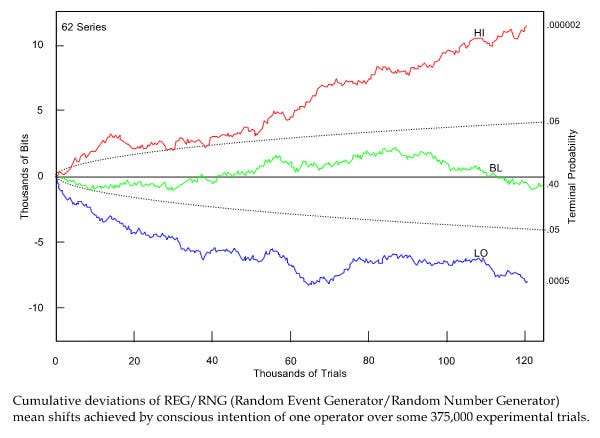
But is there any evidence that purely mental events can affect the physical world of matter, space, and time? Yes! There have been stories of people changing the world through their thoughts in myths and religious texts going back thousands of years. From 1979 - 2007, Robert Jahn and Brenda Dunne, working from their base in the Princeton University School of Engineering, did hundreds of experiments demonstrating with scientific precision that mind can affect matter. In their signature experiment, with more than 25 years’ of data’, volunteers who came to the lab were asked to sit in front of a computer screen for a few minutes and set their mind to influencing quantum events. The events were transcribed as bits of data, 1s and 0s. The statistical difference between the totality of times people were trying to increase the ones and the times people were trying to increase the zeros grew over time until it was statistically significant at the 1 in a million level.
Later experiments were conducted by Dean Radin, in which the results of a partial quantum measurement could be observed when experimental subjects merely imagined in their minds a beam of light particles going through a double slit.
Both Radin and Jahn produced results that were impressive statistically only because of large numbers of trials. The bias in any given trial was too small to be observed. My hypothesis is that this is because human experimental subjects relate to these experiments as an amusing diversion. They have nothing at stake. When life itself is creating its future through promoting rare quantum events, there is an incentive to get it right.
A systematic program of observations can guide a quantum system from one state to another
Johnjoe McFadden is a professor of molecular genetics at University of Surrey, UK. In 2004, he gave us a book which, for the first time, offers a basis in quantum physics for understanding the fossil record of evolution. Natural selection works as Darwin described it, but mutations are not “random” events. They are guided by consciousness, a process akin to biasing quantum randomness documented by Jahn and Dunne. Consciousness is directing evolution in order to create ever more complex and interesting vehicles for itself.
You’ve probably heard that one of the founding principles of QM is that every measurement changes what is being measured. This is the basis for the Uncertainty Principle, which inspired Heisenberg to invent his quantum formalism. In an application of this idea, repeated measurements can maintain a system in a quantum state from which it might (without these measurements) gradually drift away. This is called the Quantum Zeno Effect, named for the Greek philosopher who “proved” that motion is logically impossible.
Drifting from a particular state is not mysterious. It is the quantum analog of a classical system moving when it is subjected to forces. If you make a measurement of an electron and the result comes up equal to X, then if there are forces at play, it won’t stay X for long. But if you don’t wait, but make the same measurement again, immediately after the first, there is a high probability that the result will again come out equal to X.
Repeating the same measurement often enough, you can stop the electron from drifting away from state X. This is a uniquely quantum effect, with no analog in classical mechanics.
(Technically: If the time between your repeated measurements is Δt, then the probability that you get a different result is proportional to Δt squared, so if Δt is small, then the probability that one time you’ll be surprised and the repeated measurement will come out differently doesn’t accumulate as fast as time is passing. By making the measurements at very close time intervals, you can keep the system in the same state for a long time with high probability.)
The Inverse Quantum Zeno Effect is a prescription for making “measurements” that gradually change, and drag the system along in tiny jumps from the state where you find it to the destination state of your choosing.
For example, suppose the tiny magnet that is an electron is pointing North, and you want it to point South. If you measure the magnet’s N/S orientation over and over, it will remain pointing N. That’s the QZE, and it’s the opposite of what you want. But suppose you rotate your measuring tool through 90 degrees and measure the East-West magnetic field—what happens then? Answer: Half the time, it will come out East and half the time West. Next repeat the measurement “North or South?” and (whether it is now E or W, either way) half of the time it will choose South. This happens without waiting for precession to happen. The two successive measurements can in fact be almost immediately after the first, but still you find that half the time the North orientation has switched to South. This simple, two-step procedure moves half the electrons from N to S orientation.
(If you’re not familiar with this property of quantum measurement, you might want to reread the last paragraph and realize how strange it is. What you choose to measure forces a choice on the system, and that forced choice actually moves the system to a new state.)
You can do better than half. Measure the electron along the 45 degree axis, so it must choose NE or SW. If it started pointing N, then it chooses NE more often than SW. Then rotate another 45 degrees and measure E or W, then NW or SE, finally measure N or S again. Now (if I’ve done the calculation correctly) you’ll find the magnet has turned from N to S ⅝ of the time.
Continuing along this line: Instead of rotating 45 degrees each time, rotate your measuring apparatus just 1 degree to the East, so the measurement is asking “almost North or almost South?” If the apparatus is just 1 degree from North, then almost all the time it chooses “almost North” and almost never “almost South”. You can continue this process with 180 measurements spaced 1 degree apart, moving the apparatus 1 degree at a time from North to South. When you’re done making these 180 measurements, the electron’s magnetic field will now be pointing South (with very high probability).
This is the Inverse Quantum Zeno Effect. You have (very probably) moved the magnet from N to S, not by applying any force to it, but only by measuring it — and (our hypothesis is that) measurement is not a physical but a cognitive process.
This IQZE provides a plausible mechanism for William James’s proposal, that the brain transcribes intent from a conscious but disembodied entity (your “soul”) and gives that intent power to create nerve impulses and, thereby, to move the body. And long before there were brains, the IQZE was working on the simpler task of guiding genetic mutations and other small changes which have led life through the evolutionary diaspora.
And in McFadden’s book, the IQZE provides the mechanism by which living systems arise and change in a directed program, far more efficiently than the Darwinian or Lamarckian systems which are dependent on chance alone.
Very thoughtful post. Love the poem. Folks may find this interesting. Dean Radin speaking of random number generator and events that focus attention around the world. https://www.youtube.com/watch?v=cnvJfkI5NVc I personally find it important to spend time in meditation to begin my day and often set intention of how I want the day to go or get an answer to a question. Very recently I asked at the beginning of the day "Should I make a trip to San Jose de Pacifico.?" I live in Mexico about 4 hours by bus from San Jose de Pacifico, a place where magic mushrooms grow. Shortly after that request I ran into a friend who was wearing a shirt that had mushrooms on the front and the back with the words "stay weird." Clear quick answer. We can affect outcomes. It is not some woo woo thing. Evolution points toward this.
Thanks for writing on this topic. I've been thinking similar thoughts, although without the scientific sophistication.
Editorial note: I think you meant sown here: "Hoyle’s universe is sewn through with intelligence."