
Closer Encounters
book review

Jason Jorjani is the only writer I have encountered who has attempted to create a new world-view, accounting for all the anomalies unacknowledged by mainstream historians, scientists, and political columnists, in addition to the many areas where the mainstream world-view serves well. What a monumentally important endeavor! How strange that he is working alone — reading very widely, to be sure, but not collaborating or working within a recognized philosophical framework or even an academic institution. We can’t blame him for being a bit mad.

There is no doubt that any expansion of conventional reality that accounts for such diverse strangeness is bound to appear to us as madness on its face. Our instincts fail us. We must re-think the foundations of our belief system. In building anew, what will we preserve, because we are most sure of it? And what will we be forced to let go of as the price for explaining more of what we know to be true?
There are six kinds of “forbidden topics”, and many people will devote whole careers to just one of them. But they remain silent or actively deny evidence that the others are real. Jorjani not only acknowledges all six areas of occult knowledge, but also attempts to tell stories — fantastical, hard-to-take-seriously stories — that draw them together. The six are
UFOs, reported encounters with extraterrestrial beings
Religions, myths, and folklore of gods, spirits, jinn, and other magical beings
Research in the paranormal, documenting abilities to read minds, to see the future, to know about things in other times and places, and perhaps to influence real world events by the power of thought alone.
Cryptopolitcs, false flag attacks, coups, assassinations, and psy-ops by a cabal that wants to install themselves in a one-world government
Forgotten periods of human history, with advanced civilizations in the deep past
A “breakaway civilization” - Groups of humans living in secret right now, in underground cities or perhaps in Antarctica, using technologies unknown in the published literature
I have a hunch these topics are related, and Jorjani has gone the distance, crafting a coherent narrative that bring them all together. The price for this is to invoke possibilities that go beyond what we know about the six topics — time travel, anti-gravity technology, alien outposts on our moon and on Mars. I think that Jorjani’s willingness to consider all these forbidden topics is a unique strength, and who can fault him if he doesn’t get the story right on his first attempt. Jorjani is 44 years old, and already has written 19 books. He has read about a huge variety of topics. What he has chosen to believe is different from what I would have chosen, but all the more reason I can learn from his perspective.
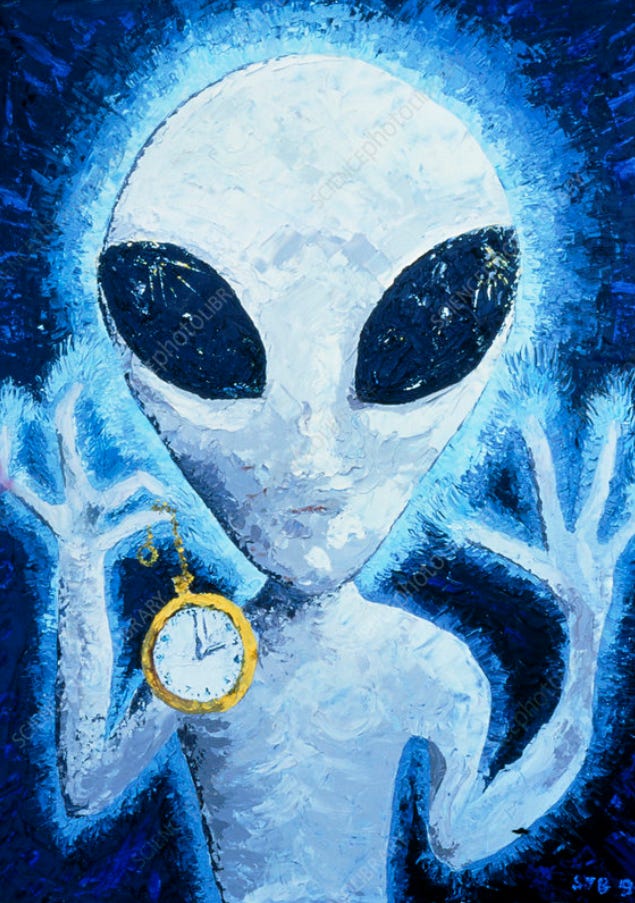
If I were to fault him at all, I would ask that he be more discerning in describing technologies that violate present scientific paradigms. I agree with him that to understand the extraterrestrial presence, we will have to stretch our minds beyond present science. But if I were working with him, I’d ask him to think more deeply about how to reconcile the performance of UFOs with the physics that seems to work so well for a wide range of phenomena on earth and in the sky.
Jorjani blurs the line between technologies based in physics and technologies based in occult practice. He believes that the Pyramids were built with technologies that are partly mental, and he reminds us that some recovered “alien” spacecraft have no cockpits or control panels, and he speculates that they are controlled by specially-trained minds. On this topic, I recommend Ross Coulhart‘s interview last February with Jake Barber.)
I put “alien” in quotes because Jorjani is not sure that these technologies originate with extraterrestrials. One of his themes is that technology developed in the 19th century was acquired and made secret by JP Morgan and JD Rockefeller. Already in the 1890s, there were “airships” that could fly faster than anything we have today. The lineage of this technology continued through Tesla into Nazi Germany, where flying saucers and anti-gravity tech were developed in the 1930s.
He quotes statements from the 1950s-90s by William P Lear (Learjet), George Trimble (Martin Aircraft) and Ben Rich (Lockheed Skunkworks). In the 1950s, they were open about technologies pursued on contract to the US DoD. “Then, in 1959, there was suddenly dead silence on the subject. Journalists who repeatedly tried to get some statement out of Martin Aircraft speculated that perhaps some breakthrough had been made that ... required the project to be branded Top Secret.”
He quotes Ben Rich (1993) “We already have the means to travel among the stars, but these technologies are locked up in black projects and it would take an act of God to ever get them out to benefit humanity...Anything you can imagine, we already know how to do.”
He says “these corporations made a Faustian bargain with the CIA and those Paperclip [Nazi] scientists doing anti-gravity work. What this also means is that the Apollo Program was a smokescreen. By the time that NASA set its sights on the Moon...there were already anti-gravity craft that could have gotten astronauts there far more effectively and comfortably than rockets carrying sardine can capsules.” Kennedy was assassinated, he says, because “he wanted to dismantle the CIA [after he] figured out that it was being run by Nazis.”
Jorjani’s style is that of an academic philosopher, carefully documented and rigorous. He has encyclopedic knowledge of Plato and Heidegger and everyone in between. Overlaid on his scholarly approach is a passionate devotion to a Nietzschean vision of the human project. We are to liberate ourselves, to expand our minds, our technologies, and our spirits. Our destiny is to become gods.
His brand of politics is easily conflated with fascism. He is unapologetically elitist, regarding human destiny as dependent on the transcendence of a few. But unlike Nazis and eugenecists, he defines the elite in terms of ability and courage and ambition. He explicitly embraces feminism and vigorously opposes racism and every form of inherited status. He writes from the standpoint of a liberator.
Readers of my Substack are aware of the environment of information warfare that surrounds us, accelerating in the 21st century. Jorjani broadens “psy wars” to Weltanschauungskrieg, translated as “world-view warfare”.
His theory is that the present disintegration of Western culture is engineered by the “Fourth Reich” Nazis whose plan is to use information warfare to make our cultures self-destruct, then plant their flag in the ashes and take over a desperate and disoriented world.
“The social conditions that have broadly been described as ‘degenerate’ by folks on the Right, ... for example, Merkel’s Germany with respect to the migrant crisis, the rootless identity politics of cultural relativism that have been used to dissolve the value systems of Western societies — all of this is being implemented by useful idiots who are involved in the bureaucracy of Western governments. When these policies are traced to the highest levels, for example Germany’s Deutsche Bank, one sees that this is all being done very deliberately in order to create a social vacuum that is going to be filled...Mass hopelessness and disorientation will be monopolized by people who will provide a new point of orientation and direction.
“Worldview warfare is the war between various forms of life, which could be whole societies, over the constitution of reality. What that further implies is that all systems of knowledge are conditioned by power relations. This includes every type of scientific theorization...
“An Abbauender Aufbruch is a “dismantling breakthrough” or a deconstruction that leads to a radical departure. Entering postmodernity — moving out of the modern paradigm — is a moment when a deconstruction takes place that allows you to consciously recognize for the first time that,regardless of what society has given us as our respective heritage, we have all been unconsciously operating within the context of one or another worldview.”
Of course, information warfare is about controlling what people believe so The Elite can channel our behavior to their own advantage. But there’s more to it than this. Jorjani believes that our collective beliefs are the sum of reality. There is no objective world out there. Shaping people’s beliefs is not just manipulating people, it is manipulating reality.
When “for the first time, we become conscious of this, which in turns gives us the power to deliberately adopt various worldviews and flip back and forth between them in order to increase our latitude of control and enhance our power or vital force. This allows one...to define reality on account of being the only ones to have deeply undergone a deconstruction of the paradigms and ideologies that had hitherto been [unconsciously limiting.] It is a question of becoming master over occultation and revelation. Once one realizes that the Greek althea or ‘unconcealment’ is the proper conception of Truth, not the Latin veritas, one can make things disappear by becoming a master of what remains occulted and what is revealed or reified from out of that occulted ‘background’.”
Though Jorjani is an elitist, he abhors the Davos set, the billionaires, and the Royal bloodlines that want to control the world. His elite is simply the people with the intellect to see past political illusions, the creativity to contribute to culture in unique ways, and the courage to shake off every vestige of conformity in their our ascent from La condition humaine to our destiny as gods.

Coda
This book is so insanely audacious, so boldly imaginative, so wild and so brilliant that I nominate Jason Jorjani as the most thought-provoking writer today. “Philosophy” for Jorjani includes history of religion, foundations of science, sociology, psychology and parapsychology. He radically reframes our understanding of history, and goes on to revise the established timelines of events, and, from there, takes off into time travel, to question the very notion that there is a fixed historic sequence of events.
Closer Encounters is his most ambitious book, and it stretches my imagination past the breaking point. He goes into realms (like time travel and alternative time-lines) where I find myself saying, “my own experience provides me no basis for thinking about such things.”
I cannot summarize the book without making it sound ridiculous, and yet that does not mean that the book can be dismissed as beyond the pale. It is rooted in a creative synthesis of anomalous anecdotes. The stories very widely in their evidence and reliability of their substantiation, but so many of these stories are both well-documented and “impossible” by standards of consensus reality, that (whether or not we buy the author’s [explanations], we are highly motivated to reconsider our foundational beliefs.
Uncomfortable. Extremely uncomfortable. But there is no better nor more important thing for us to be doing in this time of epic transition.
Thanks Josh. I seek to uncover, to see, and try to reveal Truth, which is a "creative" process within "reality".
I appreciate your views on this book and this creative-synthetic analysis of Jason Jorjani.
Thank you very much for your honest and comprehensive analysis. And for pointing out it is uncomfortable as well as essential in our difficult times. I think we need to question our certainties, the thing we use to take for granted.
I agree with (most of) what you present about Jason Jorjani’s book.